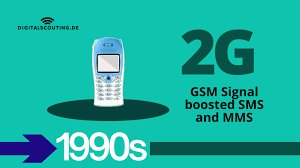
The second generation of mobile networks, or 2G, was launched under the GSM standard in Finland in 1991. For the first time, calls could be encrypted and digital voice calls were significantly clearer with less static and background crackling.
But 2G was about much more than telecommunications; it helped lay the groundwork for nothing short of a cultural revolution. For the first time, people could send text messages (SMS), picture messages, and multimedia messages (MMS) on their phones. The analog past of 1G gave way to the digital future presented by 2G. This led to mass-adoption by consumers and businesses alike on a scale never before seen.
Although 2G’s transfer speeds were initially only around 9.6 kbit/s, operators rushed to invest in new infrastructure such as mobile cell towers. By the end of the era, speeds of 40 kbit/s were achievable and EDGE connections offered speeds of up to 500 kbit/s. Despite relatively sluggish speeds, 2G revolutionized the business landscape and changed the world forever.
-
Subscribe
Subscribed
Already have a WordPress.com account? Log in now.
 5gnetwork